
Case study · Battery manufacturer
Getting an e-bike battery ready for the 2027 battery passport
How KuziDesign, a battery maker with two sites (a pack assembly plant and a UK service centre), would give every e-bike battery its own passport, serial number and state-of-health record in xProduct.
01
The challenge
Under the EU Batteries Regulation (EU) 2023/1542, batteries for light means of transport (LMT), such as e-bikes and e-scooters, placed on the market or put into service in the EU or Northern Ireland need a battery passport from 18 February 2027. From the same day every battery needs a QR code.
The passport duty also applies to electric-vehicle batteries and to industrial batteries above 2 kWh. The 2 kWh limit is for industrial batteries only. An e-bike battery is an LMT battery (a sealed battery of 25 kg or less for wheeled electric vehicles; this one weighs 2.9 kg), so at 504 Wh it still needs a passport.
Other LMT duties come later: removability by an independent professional from 18 February 2027, carbon footprint rules from 18 August 2028 at the earliest, recycled content documentation from 18 August 2033.
The Regulation asks for a passport for each individual battery placed on the market, not just one per model. For a pack maker that changes the job. A spec sheet per SKU is no longer enough. Every battery needs its own identity, its own QR code, and a record that follows it through use, repair, second life and recycling.
In our example, the manufacturer's data was spread out:
- Two sites. Batteries are built at the KuziDesign pack assembly plant and tested, repaired and returned through the KuziDesign Service Centre UK. Batch records, serial numbers and test results sat in separate spreadsheets at each site.
- Units per SKU. Nobody could say quickly which serials belonged to which batch, which site built them or when.
- State of health. Capacity, resistance and cycle data came from test benches and the field, but they were not tied to individual serials.
- Documents. The declaration of conformity, safety and transport test reports and end-of-life information lived in shared folders.
- Who sees what. Some battery data is for everyone, and some, like dismantling steps and detailed composition, is only for repairers, recyclers and authorities.
- The EU DPP Registry. Battery identifiers will need to be registered, and that meant yet another file to build by hand.
02
What they needed
- One place for model data, with a passport per individual battery.
- Batches tied to the plant that built them, and service records tied to the UK service centre.
- A fixed, repeatable list of production steps per product line.
- State-of-health readings per serial, kept as a history that is only added to, never overwritten in the app.
- Public, professional and authority-only access levels.
- Labels and QR codes they can print, plus a Registry file.
03
How they set it up in xProduct
Created the battery product
With its GTIN and the three battery sections: Battery label (category, chemistry, hazardous substances, critical raw materials, place of manufacture), Battery performance (capacity, voltage, power, cycle life, efficiency, resistance, temperature range, warranty) and Battery restricted data.
Added both sites
On the account's factory and partner lists: the pack assembly plant as the factory each batch is built in, and the UK service centre as the site that records tests, repairs and returns against each serial.
Built a step template
For the product line (for example "Li-ion pack 10S4P") from the step library. Each new batch copies its own steps. Operators record start, finish, line and notes, and recorded steps cannot be removed.
Created batches
With a batch code, factory, quantity and dates. From a batch, the Units button suggests serial numbers from the batch code and the number still missing.
Added units per SKU
By number range or pasted list, up to 1,000 at a time. Serials are unique within the product. Each unit gets its own passport link, which cannot be guessed, and its own QR code with the GS1 Digital Link and serial.
Printed labels
From the QR label sheet (30, 38 or 48 mm codes), or exported a CSV for their own label printer.
Recorded state of health per unit
Readings are added, never edited, and the newest one is shown. Bulk import takes up to 5,000 lines by CSV or paste, and test systems can post readings through the API.
Uploaded documents
And set each one as public, professional or authority-only. The restricted battery section is never public and is left out of the PDF export.
Invited partners
Return, repair and recycling partners get time-limited links or partner sign-ins. They log events with photos against a serial, and the manufacturer approves or rejects them.
Downloaded the EU Registry file
The batteries' identifiers as JSON or XML, in the format prepared for the EU DPP Registry's file upload (the Registry's semantic checks are not available yet).
04
What the passport shows
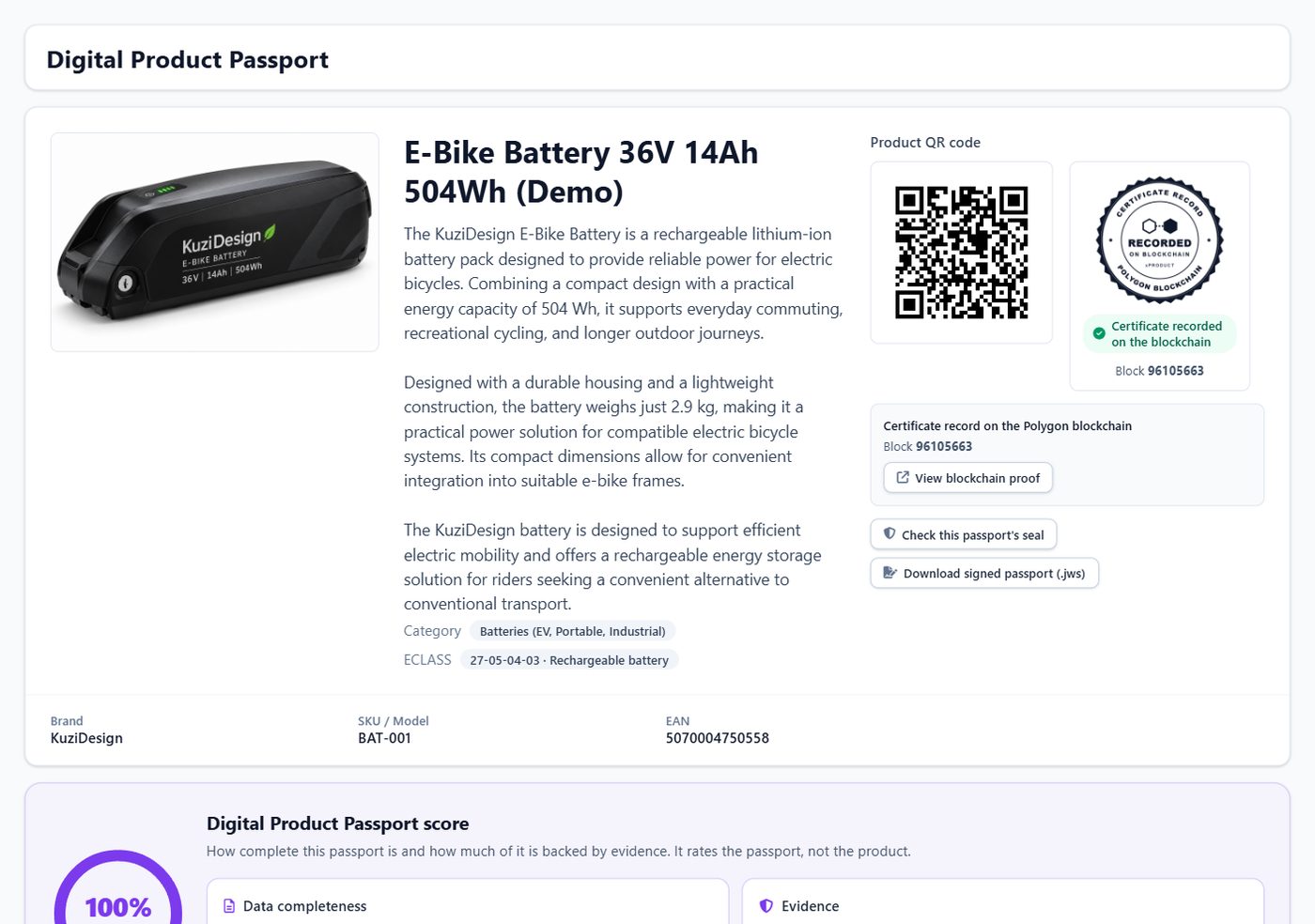
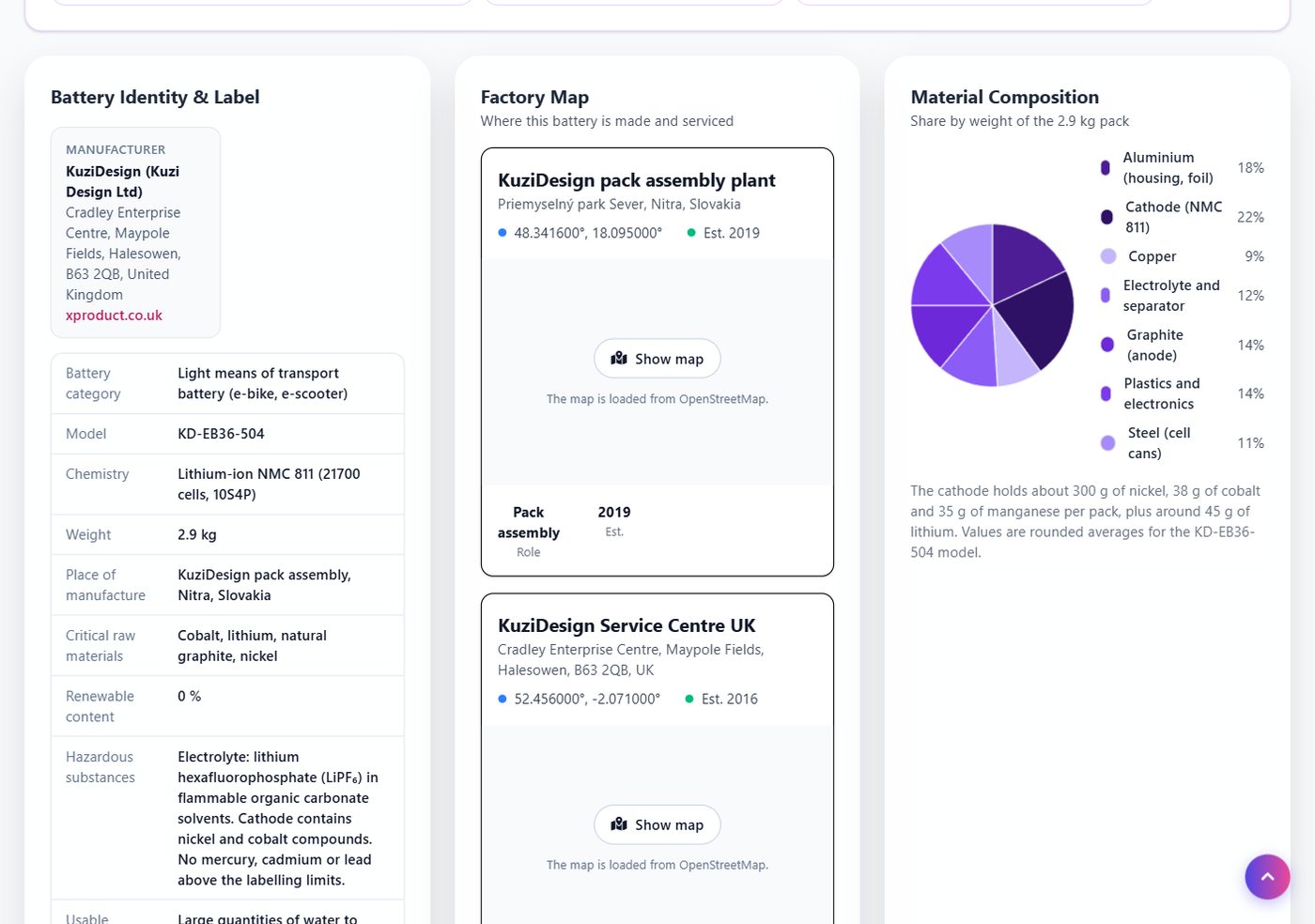
Open the live passport. It shows:
- Identity: model, GTIN, GS1 Digital Link and classification.
- Battery label: LMT category, NMC 811 chemistry with 21700 cells (10S4P), 2.9 kg, critical raw materials (cobalt, lithium, natural graphite, nickel), the extinguishing agent and separate-collection marking.
- Performance: 14 Ah, 0.504 kWh, 36 V nominal, 1,000 cycles to 70% capacity, 95% efficiency at start.
- Spare parts for 7 years, with prices and who may fit them, plus service points in the UK and Slovakia.
- Example certificates. These are demo documents, not third-party certificates.
- A passport seal you can check, a signed passport file (.jws) to download and a blockchain certificate record on Polygon. Together they make changes tamper-evident.
05
What this setup gives
- Each battery can have its own passport, serial number and QR code.
- Each unit can show its batch, the site that built it and when it was made.
- Production steps can be recorded per batch, the same way at every site.
- State of health can be kept per battery, as a history that is only added to, never overwritten in the app.
- Restricted data can be limited to repairers, recyclers and authorities.
- The Registry file can come from the same data, not a separate spreadsheet.
06
What's next
Repurposed or remanufactured batteries can get a new linked passport, so a battery's second life stays traceable. The same units and battery sections also work in the DigiPass Shopify app for brands that sell direct.
Next case study
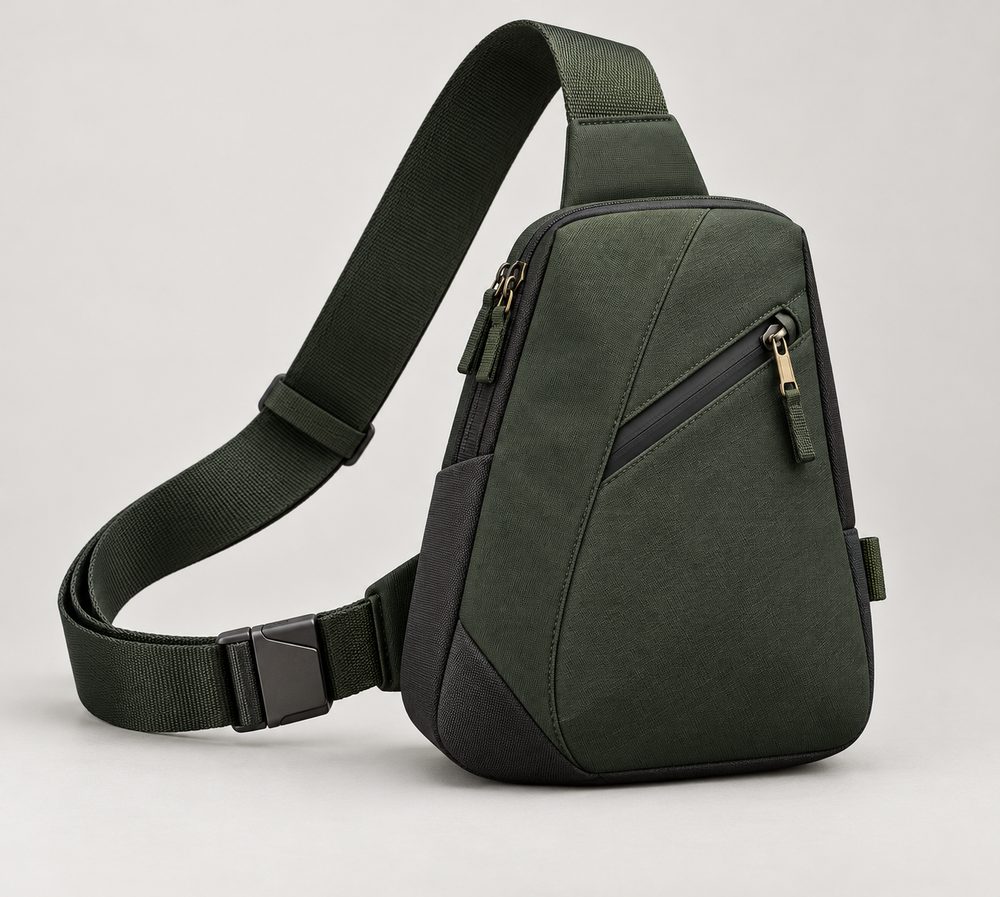
A small bag brand with a passport, warranty and repair information
Read the case study
Get ready before February 2027
Book a demo to see this battery passport in the demo account, or start free.
This example helps prepare for the battery passport rules. It is not legal advice, and you should check your own obligations.