
Food passports, one code for label, lot and pack
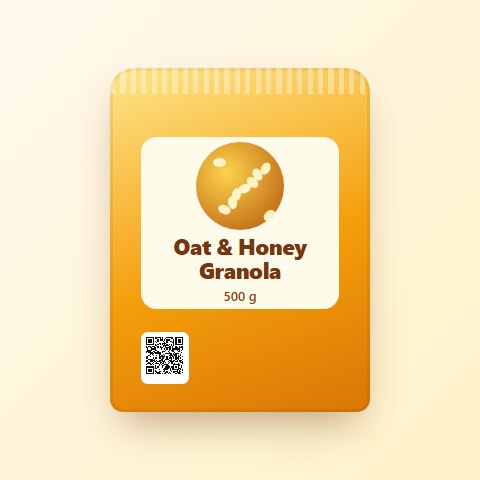
No law asks for a food product passport: food is outside the EU's Ecodesign passport rules. But food law already asks for traceability and clear labels, and the new packaging rules apply since 12 August 2026. xProduct keeps ingredients, nutrition, lots, certificates and packaging data in one passport, reached by a QR code on the pack.
Rules on this page
- General Food Law (EC) 178/2002
- FIC (EU) 1169/2011
- FCM (EC) 1935/2004
- BPA (EU) 2024/3190
- PPWR (EU) 2025/40
- EUDR (EU) 2023/1115
- EmpCo (EU) 2024/825
- UK packaging EPR · SI 2024/1332
30 December 2026: deforestation rules for cocoa, coffee, palm oil, soya and beef
From this date, large and medium companies that place these commodities, or listed products made from them such as chocolate, on the EU market must file a due diligence statement with the geolocation of the plots where they were produced. Micro and small companies follow on 30 June 2027.
No food passport law
Food and feed are outside the Ecodesign Regulation, so no passport date is set for food. A food passport is your choice.
01/What applies
The rules that already reach food
Food has no passport law, but three sets of rules already ask for the data a passport can hold: food law for the food and its label, packaging law for the pack, and the deforestation rules for some ingredients.
The food and its label
Every food business, from the farm to the shop, in the EU, Northern Ireland and, under assimilated law, Great Britain.
- Know your suppliers and your business customers: one step back, one step forward
- Ingredients with the allergens emphasised, and the nutrition declaration, on the label
- Online, the same information before purchase, apart from the date mark
The packaging
Anyone who packs food under their own name, imports it or sells it, and the makers of the packaging itself.
- No PFAS above the limits in food-contact packaging
- A declaration of compliance for plastic food-contact materials
- Recyclable packaging and minimum recycled content, expected from 2030
- Producer registration and EPR in each country
Cocoa, coffee, palm oil, soya and beef
Companies that place these commodities, or listed products made from them, on the market or export them.
- A due diligence statement in the EU information system, with the geolocation of the plots of land
- Only the first company that buys from the operator keeps the due diligence reference numbers; companies further down the chain no longer file their own statement
- Micro and small companies from 30 June 2027
02/How it works
From pack to passport in seven steps
The same steps for a jar of honey and a box of cereal. Fill them in at your own pace and publish when the passport is complete.
- 01
Choose the food category
The category decides which passport sections you can choose from, such as ingredients, nutrition and packaging.
Food - 02
Add the product
Name, GTIN, pictures and a description, and a product class from 41 food classes in ECLASS, such as bakery products, fruit and vegetables.
GTINECLASSPictures - 03
Write the ingredients and allergens
The ingredients list in the words of your label, with the allergens in bold, and an allergy box for notes such as "may contain nuts".
IngredientsAllergy box - 04
Add the nutrition values
The nutrition declaration per 100 g and per portion with reference intakes, a front-of-pack summary and, if you use it, the Nutri-Score grade.
Per 100 gPer portionNutri-Score - 05
Describe the packaging and attach certificates
Each packaging level with its materials, weights, recycled content and sorting instructions. Organic and other certificates with their dates; on a paid plan, upload a file and its details are filled in for you to check.
PackagingCertificates - 06
Record your batches
On the Manufacturer plan, record each production batch with its code, factory, quantity, dates and the production steps it went through.
BatchFactorySteps - 07
Publish and print the code on the pack
The passport goes live, free to open with no sign-up. Print its QR code on the pack, or use a GS1 Digital Link address with your GTIN and lot number.
QRGS1NFC -
Try it
Build your first food passport on the free plan
No card needed. Add one product and see the passport a shopper will see.
03/The law
What the rules ask of food businesses
A food passport is voluntary. The rules below are not: they decide what must be on the label, what must be traceable and what the packaging must meet. A passport can hold the same data in one place.
A summary of the rules as of November 2026, not legal advice. Dates marked "may move" depend on EU acts that have not been adopted yet.
- 01
Ecodesign (ESPR): food is not covered
The Ecodesign for Sustainable Products Regulation (EU) 2024/1781, which brings digital product passports to many product groups, does not apply to food or feed (Article 1(2)). No EU or UK law asks for a food product passport. A food passport is a way to share more than fits on the label.
- 02
General Food Law: traceability and recalls
Regulation (EC) No 178/2002 asks every food business to know who supplied each food and ingredient, and which businesses it supplied: one step back, one step forward (Article 18). If a food may be unsafe, the business must withdraw it and, if it may have reached consumers, inform them and recall it (Article 19). Recalls go through the food authorities; a passport does not replace them.
- 03
Food information (FIC): the label
Regulation (EU) No 1169/2011 sets what the label must show, including the name, ingredients with the 14 listed allergens emphasised, net quantity, date mark, storage conditions, the business name and address, and the nutrition declaration. Food sold online must show the same information before purchase, apart from the date mark (Article 14). A QR code cannot replace the label: the mandatory information stays on the pack.
- 04
The exception: wine
For wine and aromatised wine products produced from 8 December 2023 (Regulation (EU) 2021/2117), the ingredients list and the nutrition declaration may be given electronically, for example through a QR code. The energy value and the allergens must still be on the label.
- 05
Food-contact materials
Under Regulation (EC) No 1935/2004, packaging and other materials that touch food must not pass substances into it in harmful amounts and must be traceable; plastics need a declaration of compliance (Regulation (EU) No 10/2011). Regulation (EU) 2024/3190 bans bisphenol A in food-contact materials: most single-use articles had to meet it by 20 July 2026, with later dates for some uses.
- 06
Packaging and Packaging Waste Regulation (PPWR)
Regulation (EU) 2025/40 applies since 12 August 2026, including limits on PFAS in food-contact packaging. Harmonised sorting labels follow from 12 August 2028, or later if the EU act that defines them is late. From 2030, or later if the EU acts that set the criteria are late, all packaging must be recyclable and plastic packaging needs a minimum share of recycled content; some single-use formats are banned from 1 January 2030. Producers register for extended producer responsibility in each country.
- 07
Deforestation Regulation (EUDR)
Regulation (EU) 2023/1115, as amended, covers cattle, cocoa, coffee, oil palm, soya, rubber and wood, and listed products made from them, such as beef, chocolate, roasted coffee and palm oil. It applies from 30 December 2026 for large and medium companies and from 30 June 2027 for micro and small companies.
- 08
Green claims (EmpCo)
Since 27 September 2026 (Directive (EU) 2024/825), generic environmental claims such as "eco-friendly" need proof of recognised excellent environmental performance, claims that a product is climate neutral because emissions are offset are banned, and sustainability labels must come from a certification scheme or a public authority.
- 09
Great Britain and Northern Ireland
In Great Britain the general food law and the food information rules continue as assimilated law. Since 1 October 2021, food prepacked for direct sale must carry its name and a full ingredients list with the allergens emphasised (Natasha's Law). Packaging EPR (SI 2024/1332) applies across the UK, and a deposit return scheme for drinks containers is planned from October 2027. Northern Ireland follows EU food law; the EUDR is expected to apply there too, but the UK has not yet confirmed how far.
04/Key dates
Dates that reach food and its packaging
Most of these dates are fixed in law. Dates marked "May move" depend on an EU act that has not been adopted yet.
- 8 Dec 2023
Wine: the ingredients list and nutrition declaration may be given through a QR code or other e-label
In force - 20 Jan 2025
Ban on bisphenol A in food-contact materials in force (Regulation (EU) 2024/3190)
In force - 20 Jul 2026
Main transition for the bisphenol A ban ends for single-use food-contact articles; some uses have later dates
In force - 12 Aug 2026
PPWR applies, with limits on PFAS in food-contact packaging
In force - 27 Sep 2026
EmpCo applies: generic green claims need proof
In force - 30 Dec 2026
EUDR applies to cattle, cocoa, coffee, oil palm and soya, and listed products made from them, for large and medium companies
Fixed date - 30 Jun 2027
EUDR applies to micro and small companies
Fixed date - 1 Oct 2027
UK deposit return scheme for drinks containers planned to start
Fixed date - 12 Aug 2028
Harmonised sorting labels on packaging, or later if the EU act that defines them is late
May move - 1 Jan 2030
Packaging must be recyclable and plastic packaging must meet minimum recycled content, from 1 January 2030 or later if the EU acts that set the criteria are late; some single-use formats are banned from 1 January 2030
May move - No date
A food product passport: food and feed are outside the Ecodesign Regulation, and no law sets a food passport
05/What is recorded
What a food passport can hold
What is on the label, and what does not fit on it: origin, certificates, packaging and storage, in one record reached by the code on the pack.
A passport adds to the food label; it does not replace it. The grey tags are the xProduct passport sections that can hold each topic.
- 01
Ingredients and allergens
The ingredients list in the words of your label, in titled blocks, with the allergens in bold and an allergy box for "may contain" notes.
Ingredients - 02
Nutrition declaration
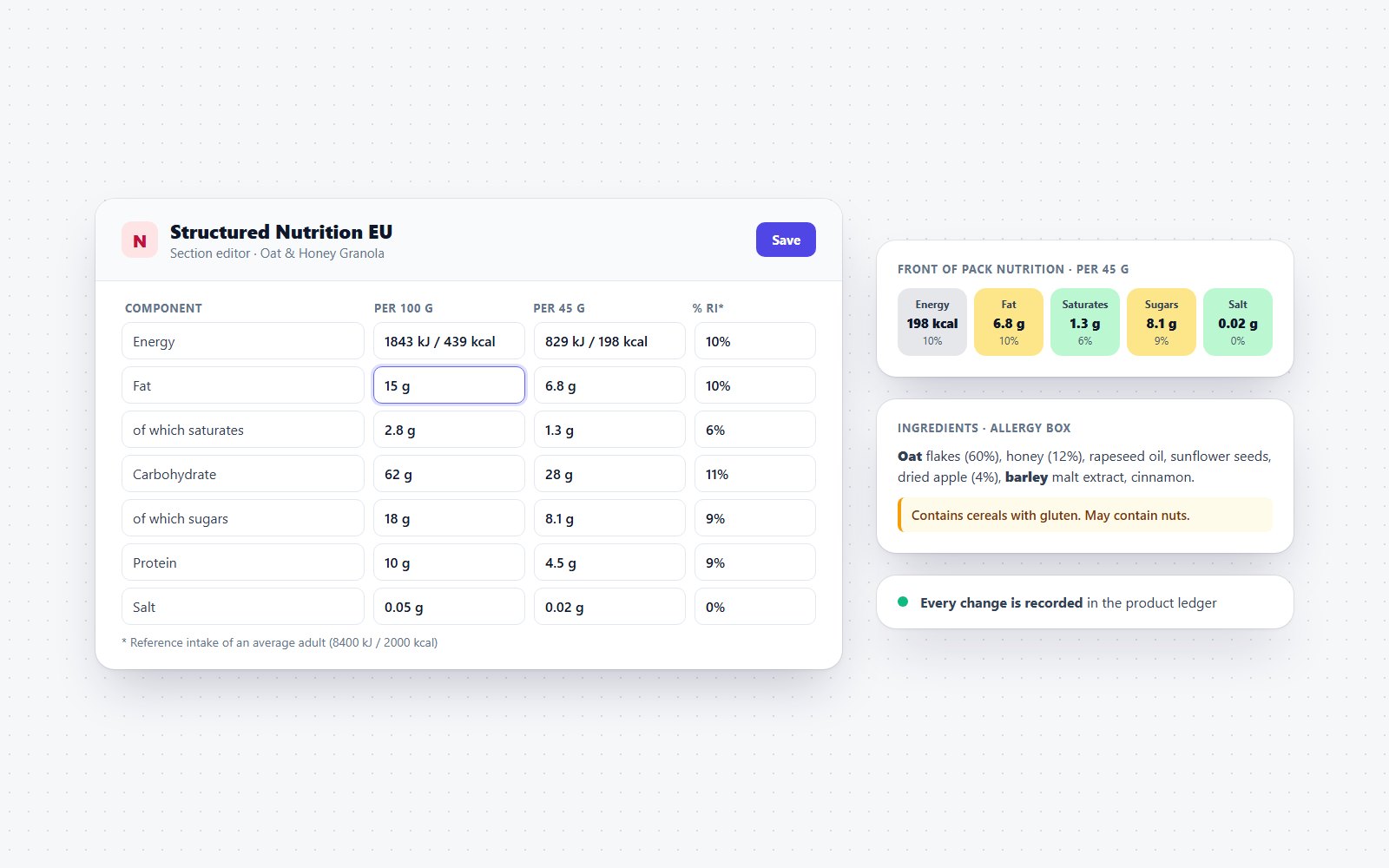
Energy, fat, saturates, carbohydrate, sugars, protein and salt per 100 g and per portion, with reference intakes and footnotes.
Structured Nutrition EUNutrition Values - 03
Front-of-pack summary
Up to five coloured tiles per portion, as on the front of the pack, and the Nutri-Score grade if you use it.
Front-of-Pack NutritionNutri-Score - 04
Storage and use
How to store the product and use it up, as a list of tips with icons.
Storage & Longevity - 05
Origin and supply chain
The shares of the main ingredients and where they come from, the steps from field to pack, and the site where the product is made, on a map.
Material SourcingSupply Chain TimelineFactory Map - 06
Certificates
Organic, quality and other certificates with their numbers, issuers and validity dates.
Certifications - 07
Packaging and end of life
Packaging levels, materials, weights, recycled content and sorting instructions, and whether a pack can be composted.
PackagingCompostabilityRecyclability - 08
Carbon footprint
A footprint you have calculated, split by life-cycle stage, with a link to the study behind it, if you choose to share it.
Carbon Footprint - 09
Responsible companies
The food business behind the product, and its importer or other companies named on the pack.
Responsible companies - 10
Other declarations
Statements about other rules that apply to the product or its packaging, in your own words.
Regulatory Compliance
06/Packaging
Packaging data, level by level
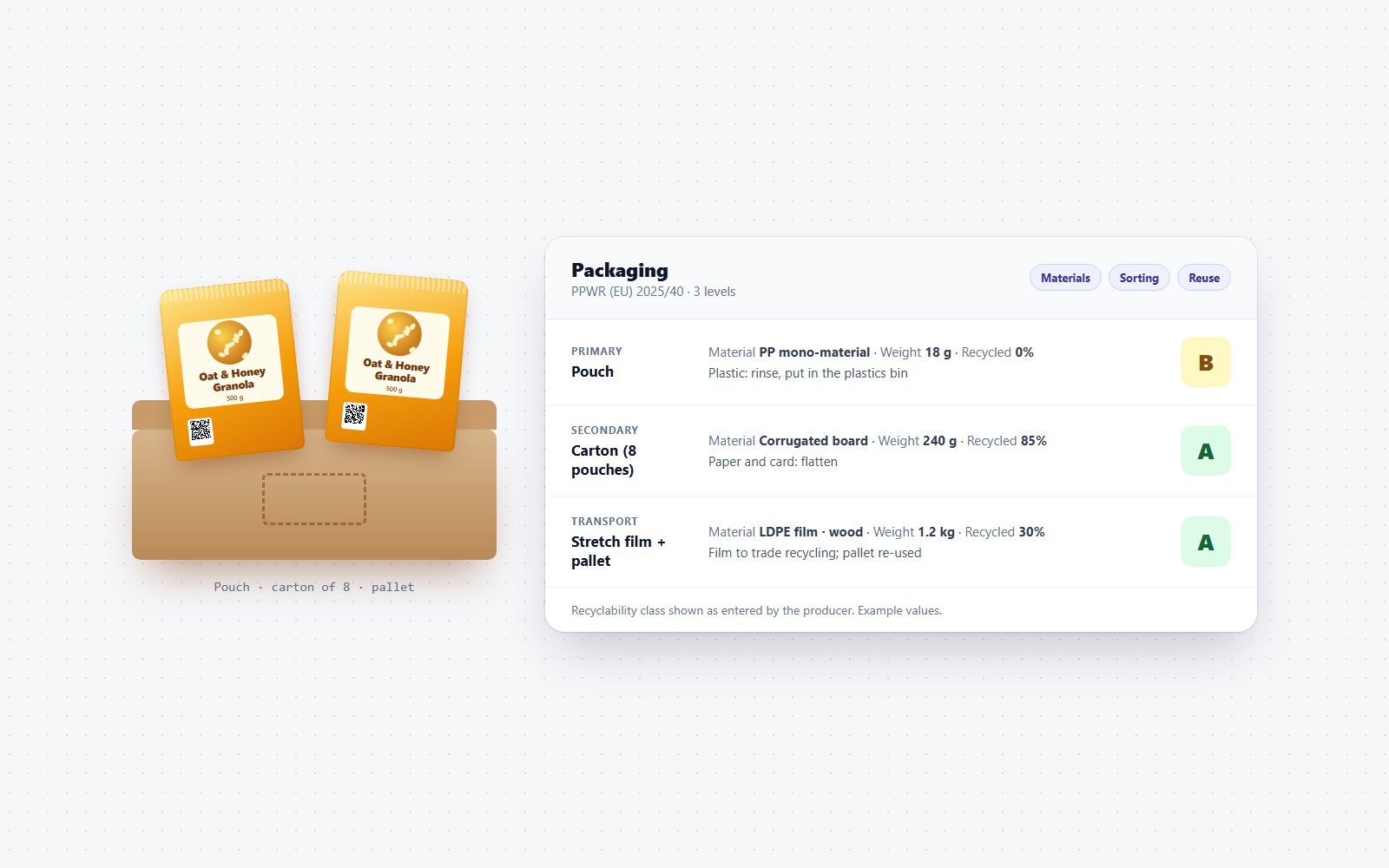
The PPWR and the UK packaging EPR ask about the pack, not the food. The Packaging section records each level, from the pouch to the pallet, in the terms those rules use.
Levels and materials
Primary, secondary, tertiary and transport packaging, each with its components, materials, weights and recycled content.
Recyclability and sorting
The recyclability class you have assessed, and sorting instructions for each component, shown on the passport.
Reuse and deposit return
Whether a pack is reusable and for how many cycles, whether it is in a deposit return scheme, and its empty space.
Data checks and export
Data checks show which packaging data a product still lacks, and the packaging data can be exported. An EPR registration number can be kept off the public passport.
07/Batches and lots
One recipe, many lots, every language
Food is made in lots and sold in many countries. xProduct keeps the lots and the language versions around one main product.
Each batch on record
On the Manufacturer plan, record each production batch with its code, factory, quantity, start and end dates and the steps it went through. If a lot is ever in question, you can see what was made, where and when.
A code that knows the lot
A GS1 Digital Link address with your GTIN and lot number opens the passport recorded for that lot. Plain QR codes and NFC tags work too.
A passport in each language
The same passport in each language you sell in, linked to the original and reached through the one code on the pack.
08/Why start now
The data is asked for already
Entering the data is quick. Collecting it from suppliers, packaging makers and labs takes months, and packaging and commodity rules ask for it now.
Packaging data comes first
The PPWR applies since 12 August 2026, and its recyclability and recycled-content rules, expected from 2030, need data from your packaging suppliers well before then. UK packaging EPR already asks for materials and weights.
Commodity origin from 30 December 2026
For cocoa, coffee, palm oil, soya and beef, the EUDR asks for the geolocation of the plots where they were produced. xProduct does not file the due diligence statement, but the passport can show origin and the supply chain.
One source for pack, shop and listing
Online shops must show the label information before purchase. Keeping it in one passport keeps your pack, your web shop and your marketplace listings in step.
On the Manufacturer and Enterprise plans, xProduct's green claims check reads your own product texts for generic claims such as "eco-friendly" and says what each kind of claim needs. It is a word list, not a legal check, and nothing from it shows on the public passport.
09/Tamper-evident
Every change recorded. Any change can be checked.
When a recipe, an allergen note or a certificate changes, people need to know what the passport said and when. xProduct writes every change to a passport, its values, its documents and its publishing, to the product's ledger, each entry linked to the one before. Every night a fingerprint of the latest entries is written to a public blockchain.
Tamper-evident means a later change can be seen and checked. It does not make the data correct: what the passport says remains the producer's statement.
- Linked entries — change an old entry and the links after it no longer match.
- A public record every night — Documents remain private off-chain. Only cryptographic fingerprints are anchored for integrity checks.
- Signed data — systems can fetch the passport as a signed copy and check it with the public keys the site publishes. A first step towards a seal, not a qualified electronic seal.
- Swapped documents show — a replaced certificate or test report is a new entry, with who changed it and when.
- The passport as it was — see the passport as it was on an earlier date, back to when its version history began.
10/Example
What a shopper sees after scanning
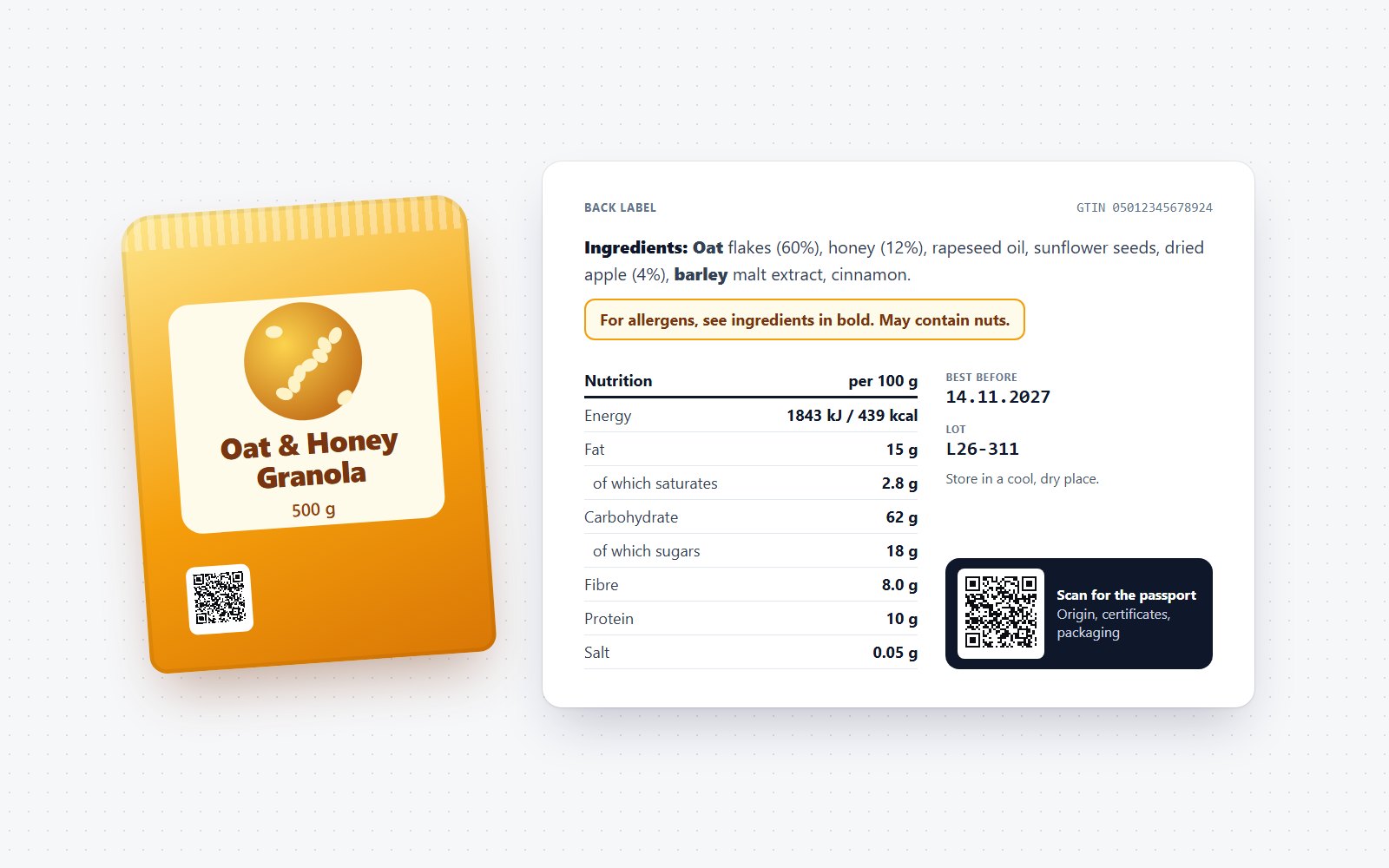
The label stays on the pack. The code next to it opens everything else: ingredients and allergens, nutrition, origin, certificates and how to sort the packaging.
- Ingredients with allergens in bold
- Nutrition per 100 g and per portion
- Certificates with their dates
- Change history you can check
11/Questions
Food passports, answered
Is a digital product passport required for food?
No. The EU's passport rules come from the Ecodesign Regulation, which does not apply to food or feed, and no UK law asks for one either. A food passport is voluntary. What is required is the label, traceability and, for the packaging, the PPWR or UK packaging EPR.
Can a QR code replace information on the food label?
No. The mandatory food information must stay on the pack. The exception is wine and aromatised wine products produced from 8 December 2023, whose ingredients list and nutrition declaration may be given electronically; their energy value and allergens stay on the label.
Does xProduct handle recalls?
No. Withdrawals and recalls go through your food authority and your customers. xProduct keeps your batch records and every change to the passport, so you can see what was made, what the passport said and when. You can also update the passport, and the change is recorded.
Who can see the passport?
Anyone who scans the code, free and with no sign-up. You choose which sections a product shows.
Does it work with Shopify?
Yes. The xProduct Shopify app has the same food sections, including ingredients, nutrition values and front-of-pack nutrition.
Where is the data kept?
xProduct runs a UK site and an EU site. Accounts on the UK site keep their data in the UK, and accounts on the EU site keep it in the EU.
Put everything behind the label in one place
Start with one product on the free plan, or book a demo and see a food passport built step by step.
A summary of the rules as of November 2026, not legal advice. Dates marked "may move" depend on EU acts that have not been adopted yet.