
Clothing passports, ready before they are required
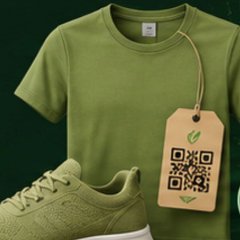
The EU plans a digital passport for clothing, expected from around 2028–2029. Unsold clothing and footwear may no longer be destroyed by large companies, apart from listed exceptions, green claims need backing, and textile take-back schemes are due by 2028. xProduct keeps fibres, origin, care, certificates, repair and end-of-life information in one passport, reached by a code on the label.
Rules and standards on this page
- ESPR (EU) 2024/1781
- (EU) 2026/296
- Textile Labelling (EU) 1007/2011
- WFD (EU) 2025/1892
- EmpCo (EU) 2024/825
- REACH (EU) 2024/2462
- GPSR (EU) 2023/988
- UK SI 2012/1102 · SI 1995/2489
17 April 2028: textile take-back schemes in every EU country
Each EU country must have an extended producer responsibility (EPR) scheme for clothing, accessories, footwear and home textiles. Producers pay for collection, sorting, reuse and recycling, and fees take fast fashion into account. Since 19 July 2026, large companies may no longer destroy unsold clothing and footwear, except in the cases the law lists.
Clothing passport expected from around 2028–2029
Textile rules are expected around 2027 and normally apply at least 18 months after they come into force. No date is set in law yet, and footwear is not included.
01/Who it affects
The rules that reach clothing first
The passport itself is still a few years away, but other EU rules reach fashion brands and sellers sooner. Most already apply, and each asks for data a passport can hold.
Large companies with unsold stock
Unsold apparel, clothing accessories and footwear may no longer be destroyed. Medium-sized companies follow on 19 July 2030; micro and small companies are exempt.
- Ten exceptions, such as unsafe or non-compliant goods, goods that infringe intellectual property, defects that cannot be repaired, or a donation refused by at least three social economy organisations
- Records of each exception kept for five years
- A yearly public disclosure of discarded unsold products, in a set format from 2 March 2027
Producers selling into the EU
Every EU country must run a producer responsibility scheme for textiles and footwear, paid for by producers.
- Clothing, accessories, hats, footwear, blankets, bed and kitchen linen and curtains
- Fees cover collection, sorting, reuse and recycling, and take fast fashion into account
- Micro-enterprises from 17 April 2029
Everyone selling to consumers
Green claims, online listings and chemical limits already apply.
- No generic claims such as "eco-friendly" without recognised excellent environmental performance, such as the EU Ecolabel, since 27 September 2026
- Manufacturer's name and addresses, and the EU responsible person, on every online offer
- PFHxA limits for clothing, leather, fur and consumer footwear since 10 October 2026
02/How it works
From garment to passport in seven steps
The same steps for a T-shirt, a coat and a pair of trainers. Fill them in at your own pace and publish when the passport is complete.
- 01
Choose the clothing category
The category decides which passport sections you can choose from, such as material composition, care, durability and recyclability.
Clothing & Footwear (Shirts, Shoes) - 02
Add the garment or shoe
Name, GTIN or SKU, pictures and a description, and a product class from 61 clothing and footwear classes in ECLASS, from shirts and dresses to shoes, swimwear and sportswear.
GTINECLASSPictures - 03
Record fibres and origin
Fibres and their shares, recycled content, where the materials come from, and the mills and factories involved.
FibresOriginFactories - 04
Add care, durability and repair
Washing, drying and ironing guidance with care symbols, expected lifespan, spare buttons or zips, and how to get a repair.
CareDurabilityRepair - 05
Attach certificates and test reports
OEKO-TEX, GOTS or EU Ecolabel certificates, test reports and declarations, each with its dates. On paid plans, upload a PDF and its details are filled in for you to check.
OEKO-TEXGOTSTest reports - 06
Name the responsible companies
Manufacturer, EU importer or authorised representative, GB importer or UK authorised representative. Enter each company once and pick it for every product.
ManufacturerImporter - 07
Publish and put the code on the label
The passport goes live, free to open with no sign-up. Print the QR code on a sewn-in label or a hang tag, or use an NFC tag or a GS1 Digital Link address.
QRNFCGS1 -
Try it
Build your first clothing passport on the free plan
No card needed. Add one garment and see the passport a buyer will see.
03/The law
What the rules ask of clothing and footwear
There is no clothing passport law yet. One is expected under the Ecodesign Regulation (ESPR) once the textiles rules are adopted; until then, the rules on unsold goods, labelling, take-back, chemicals, product safety and green claims already apply or have fixed dates.
A summary of the rules as of November 2026, not legal advice. Dates marked as estimates are not set in law.
- 01
Ecodesign (ESPR): textiles are a priority group
The ESPR (Regulation (EU) 2024/1781) has been in force since 19 July 2024. The Commission's first working plan, adopted on 16 April 2025, names textiles and apparel as a priority product group, with rules expected around 2027; no rules have been adopted yet. Rules normally apply at least 18 months after they come into force, so a clothing passport is expected from around 2028–2029. The planned rules cover apparel and clothing accessories, not footwear: a footwear study is due by the end of 2027, and footwear will be looked at again in the 2028 review.
- 02
No destroying unsold clothing and footwear
Since 19 July 2026, large companies may not destroy unsold apparel, clothing accessories and footwear. Medium-sized companies follow on 19 July 2030; micro and small companies are exempt. Delegated Regulation (EU) 2026/296 lists ten exceptions, such as unsafe or non-compliant products, products that infringe intellectual property, damaged or unhygienic products, defects that cannot be repaired, or a donation refused by at least three social economy organisations, and records must be kept for five years. Large companies must also publish each year what unsold consumer products they discard; Implementing Regulation (EU) 2026/2 sets the format from 2 March 2027.
- 03
Textile labelling: fibre names and composition
Regulation (EU) No 1007/2011 still sets the fibre names and how fibre composition is labelled. A revision, expected to add digital labelling that builds on the passport and language-free symbols, has not been proposed: the European Parliament's tracker shows it as blocked. Until a new law is adopted, the physical label stays as it is.
- 04
Textile take-back (EPR): Directive (EU) 2025/1892
In force since 16 October 2025, to be written into national law by 17 June 2027. Each EU country must have an extended producer responsibility scheme for textiles and footwear by 17 April 2028, and for micro-enterprises by 17 April 2029. Producers pay for collection, sorting, preparing for reuse and recycling, and fees take fast and ultra-fast fashion into account. It covers clothing, accessories, hats, footwear, blankets, bed and kitchen linen and curtains. Separate collection of textiles has been required since 1 January 2025.
- 05
Green claims (EmpCo)
Since 27 September 2026 (Directive (EU) 2024/825), generic claims such as "eco", "green" or "environmentally friendly" need recognised excellent environmental performance, such as the EU Ecolabel. Sustainability labels must come from a certification scheme or a public authority, a claim about the whole product may not rest on one part of it, and "climate neutral" product claims based on offsetting are banned. Countries are writing it into national law unevenly, so check each market. The separate Green Claims Directive is stalled and is not law.
- 06
Chemicals (REACH): PFHxA
Since 10 October 2026 (Regulation (EU) 2024/2462), clothing textiles, leather, fur and consumer footwear must stay under limits for PFHxA and related substances; other consumer textiles follow on 10 October 2027. The existing REACH restrictions for textiles and footwear (Annex XVII), such as for certain azo dyes and for substances that are carcinogenic, mutagenic or toxic for reproduction, still apply. A wider PFAS restriction is being prepared and is not law yet. France has banned PFAS in consumer clothing and footwear since 1 January 2026.
- 07
Product safety (GPSR): online listings
Since 13 December 2024, in the EU, every online offer must show the manufacturer's name, postal and electronic address, the EU responsible person if the manufacturer is outside the EU, a picture and identifier of the product, and its warnings or safety information in the local language. A passport or QR code helps, but does not replace this information on the listing.
- 08
Great Britain and Northern Ireland
In Great Britain the Textile Products (Labelling and Fibre Composition) Regulations 2012 enforce the retained EU textile labelling rules, and the Footwear (Indication of Composition) Labelling Regulations 1995 ask for the materials of the upper, the lining and sock, and the outer sole, by pictogram or in English. Since 6 April 2025 the CMA can fine up to 10% of global turnover for breaking consumer law; its Green Claims Code and its 2024 guide for fashion brands apply. UK textile take-back (EPR) is under discussion, with no scheme or date yet. Northern Ireland follows EU product rules for many goods under the Windsor Framework.
Not law yet: a date for the clothing passport, any passport for footwear, a digital textile label, the Green Claims Directive, and a UK textile take-back scheme.
04/Key dates
The road to the clothing passport
Most dates are fixed in law. The passport dates are estimates from the Commission's working plan, and are marked as such.
- 13 Dec 2024
GPSR applies in the EU: what online listings must show
In force - 1 Jan 2025
Separate collection of textiles required in every EU country
In force - 6 Apr 2025
UKThe CMA can fine up to 10% of global turnover for breaking consumer law, including misleading green claims
In force - 16 Apr 2025
ESPR working plan 2025–2030 adopted: textiles and apparel are a priority product group
Adopted - 16 Oct 2025
Textile EPR directive (EU) 2025/1892 in force
In force - 1 Jan 2026
France bans PFAS in consumer clothing and footwear
In force - 19 Jul 2026
Large companies may no longer destroy unsold clothing, clothing accessories and footwear
In force - 27 Sep 2026
EmpCo applies: generic green claims need recognised excellent environmental performance
In force - 10 Oct 2026
PFHxA limits for clothing textiles, leather, fur and consumer footwear
In force - 2 Mar 2027
The set format for publishing discarded unsold products applies
Fixed date - 17 Jun 2027
EU countries must have written the textile EPR rules into national law
Fixed date - 2027
ESPR rules for textiles and apparel expected to be adopted
Estimate - 10 Oct 2027
PFHxA limits extend to other consumer textiles
Fixed date - End of 2027
Study on footwear due
Estimate - 17 Apr 2028
Textile and footwear EPR schemes in place in every EU country
Fixed date - 2028
ESPR mid-term review: footwear to be looked at again
Estimate - 2028–2029
Clothing passport expected to apply, normally at least 18 months after the textile rules come into force
Estimate - 17 Apr 2029
Textile EPR schemes cover micro-enterprises too
Fixed date - 19 Jul 2030
The ban on destroying unsold clothing and footwear, and the yearly disclosure, extend to medium-sized companies
Fixed date - Not set yet
Revision of the EU textile labelling rules, including a digital label: not proposed
- Not set yet
UKUK textile take-back (EPR): under discussion, no scheme or date
05/What is recorded
What a clothing passport records
Clothing and footwear are increasingly expected to carry transparent product information: what it's made from, where it came from, how to care for it, and how to recycle it. xProduct helps you publish that information as a structured, QR-accessible record where later changes can be seen and checked.
The EU has not fixed the clothing data list yet. The Commission's study looks at durability, care, repair, recycled content, recyclability and substances of concern, and fibres, origin and care are expected to be included. The grey tags are the xProduct passport sections that can hold each topic; how many a passport uses depends on your plan.
- 01
Fibre composition
Break down fibres, blends, coatings, and component materials.
Material Composition - 02
Recycled content
Publish recycled content percentages with supporting evidence.
Recycled ContentRecycled Material Sources - 03
Origin, mills and factories
Where the fibres were grown or made, and where the fabric was spun, dyed and sewn, with the suppliers you choose to name.
Material SourcingSupply Chain TimelineSupply Chain TransparencyFactory Map - 04
Care
Clear washing/drying/ironing guidance with best practices.
Care InstructionsCare Label Instructions - 05
Durability and repair
Expected lifespan, how to keep the garment longer, spare buttons or zips, and where to get a repair.
Durability & LifespanRepairability ScoreSpare Parts & Service - 06
Certificates
OEKO-TEX, GOTS or EU Ecolabel certificates with their numbers and validity dates, and what each one means for the buyer.
CertificationsCertification Benefits - 07
Substances
Test reports and declarations for restricted substances, such as PFHxA, and the materials that carry a risk.
Regulatory ComplianceMaterial Risk Analysis - 08
Footprint
Show savings (water/energy/emissions) using transparent assumptions.
Carbon FootprintEnvironmental SavingsSustainability Score - 09
Packaging
Packaging levels, materials and weights, recyclability, recycled content and sorting instructions.
Packaging - 10
End of life and take-back
Where to return, resell or recycle the garment, and which parts can be composted or recycled.
RecyclabilityTake-Back ProgramReturn ProgramsUpcycling OptionsCompostability
06/Green claims
"Eco" is not enough any more
Fashion labels and product pages are full of green words, and both the EU and the UK now ask for proof. Say the specific fact, and keep the certificate behind it.
What the EU rules mean for a label or a product page
- "Eco-friendly hoodie" Generic Not allowed without recognised excellent environmental performance, such as the EU Ecolabel.
- "Climate neutral T-shirt" Offset Banned as a product claim when it rests on offsetting.
- Your own green leaf label Label Must be based on a certification scheme or set by a public authority.
- "Made with 30% recycled polyester" Specific Fine when it is true: keep the evidence, and say which part of the garment it covers.
In the UK: the CMA's Green Claims Code and its September 2024 guide for fashion brands cover clothing, footwear and accessories, and since 6 April 2025 the CMA can fine up to 10% of global turnover.
The green claims check
On the Manufacturer and Enterprise plans, xProduct reads your own product texts on the product page for green claims and says what each kind of claim needs, under EmpCo and the UK rules.
- Reads names, descriptions, every language version and the passport sections
- Sorts each claim as generic, offset, future or specific
- For the certificate item, the check counts only a certificate from a certification scheme, such as GOTS or the EU Ecolabel; declarations and test reports are not counted for that item
- On the product page and in Compliance → Regulations
It is a word list, not a legal check, and nothing from it shows on the public passport.
07/Sizes, colours and units
One style, every size and colour, and a code for each piece
A single style can mean dozens of sizes and colours, sold in several languages. xProduct keeps them together around one main product.
Sizes and colours
Add each size or colour as a variant of the main product, with a short code such as XL or BLK. Each variant has its own passport and code, and the passport shows the other sizes and colours as links.
A passport in each language
Add a language version for each market you sell in. Buyers switch language on the passport, and the green claims check reads every version.
Serial numbers when you want them
Give each piece a serial number with its own passport address and QR code, from 10 units on the free plan to 10,000 on the Manufacturer plan. Link pieces to a production batch and its steps on the Manufacturer plan. Useful for warranty, repairs and resale.
Buy Clothing Tags & QR Sticker Labels
Order clothing QR labels and QR sticker labels from our label shop, with a discount on paid plans. An NFC tag in the label opens the same passport; xProduct gives you the NFC file.
08/Repair, resale and recycling
Repairs, resale and recycling, on record
A good jacket has several owners. Invite the partners who take back, repair and recycle your clothing, and keep each piece's history in one place.
Repair and return partners
Tailors, repair services, returns centres and recyclers record their work on the passport, so the next owner sees what was done.
- On the Manufacturer plan, return, repair and recycling partners each get their own access
- A repair names the parts repaired, replaced, removed or installed
- Partners record their work against a product or one piece's serial number, or by pasting the link from the piece's QR code. Systems can send the same events through the API
- A warranty policy for bags and clothing is ready to adapt: 24 months on seams, zips, buckles, straps and lining, and 12 months more when the buyer registers within 90 days
Resale, take-back and recycling
Tell the owner what to do with a piece they no longer wear, and keep the history when it is sold on or remade.
- A repurposed or remanufactured piece gets its own serial number and passport, linked to the original; the original keeps its history. A resold piece keeps its passport, marked Re-used
- Each piece has a status: Original, Re-used, Repurposed, Remanufactured or Waste
- Take-back, return, upcycling and recyclability sections tell the owner where the piece can go next
09/For Shopify stores
Selling fashion on Shopify? Every size gets a passport
The xProduct apps for Shopify bring your catalogue in and put the passport on your product pages.
- Import your products: the clothing category is picked from words such as shirt, dress, hoodie, jacket or sneaker
- Every size and colour becomes its own passport, with its SKU and barcode
- Theme blocks for the passport and its highlights follow the size or colour the shopper picks
- Two apps: DigiPass EU and DigiPass UK
10/Why start now
The data is needed before the passport is
Entering the data is quick. Collecting it from mills, dyers and factories takes seasons, and other rules ask for it sooner.
Supplier data takes a season
Fibre shares, recycled content and origin come from your suppliers. Ask now, and the data is in place when the textile rules are adopted, expected around 2027.
Unsold stock needs records
Large companies may discard unsold clothing only under the listed exceptions, keep records for five years, and publish each year what they discard, in a set format from 2 March 2027.
Green claims need proof now
Since 27 September 2026, "eco" on its own is not allowed in the EU without recognised excellent environmental performance, such as the EU Ecolabel, and in the UK the CMA can fine up to 10% of global turnover. A passport shows the specific fact behind a claim, such as a GOTS certificate and its dates.
11/Tamper-evident
Every change recorded. Any change can be checked.
A garment can be resold, repaired and recycled by people who never met the brand, so they need to trust its passport. xProduct writes every change to a passport, its values, its documents and its publishing, to the product's ledger, each entry linked to the one before. Every night a fingerprint of the latest entries is written to a public blockchain.
Tamper-evident means a later change can be seen and checked. It does not make the data correct: what the passport says remains the brand's statement.
How the integrity check worksProduct Ledger: every change becomes traceable
- 01
Update occursContent or template changes
- 02
Ledger entryNew version + fingerprint
- 03
Check integrityCompare the current data with its recorded fingerprint
- Linked entries — change an old entry and the links after it no longer match.
- A public record every night — Documents remain private off-chain. Only cryptographic fingerprints are anchored for integrity checks.
- Signed data — systems can fetch the passport as a signed copy and check it with the public keys the site publishes. A first step towards a seal, not a qualified electronic seal.
- Swapped documents show — a replaced certificate or test report is a new entry, with who changed it and when.
- The passport as it was — see the passport as it was on an earlier date, back to when its version history began.
12/Live example
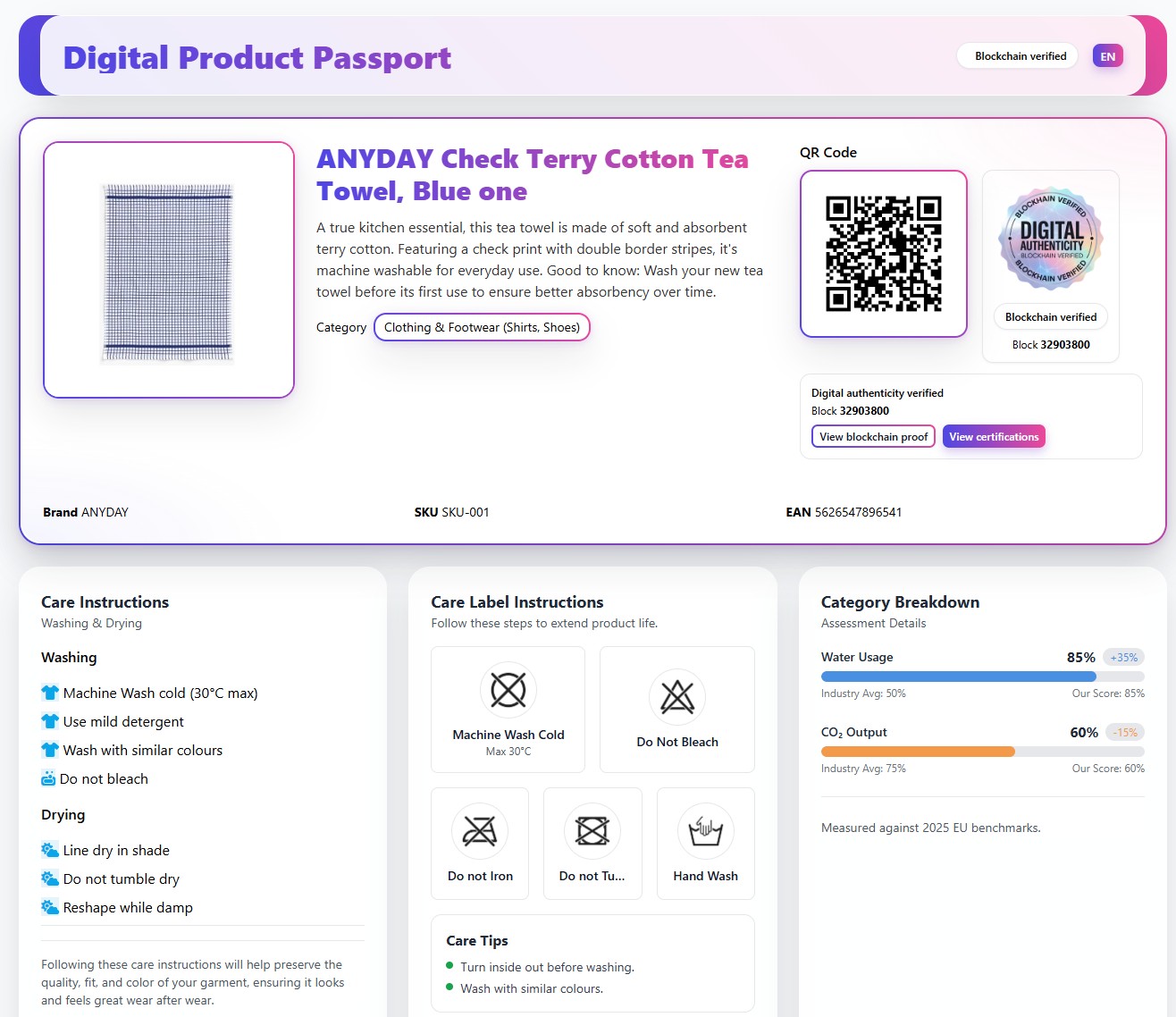
See a live passport from the Clothing & Footwear category
Give customers clear care instructions, longevity tips, certification transparency, and recycling guidance — in one scan.
- Care instructions and care label symbols
- Materials and certificates
- Change history you can check
- Opens on any phone, with no app and no sign-up
Get your clothing data ready, one style at a time
Start with one garment on the free plan, or book a demo and see a clothing passport built step by step.
A summary of the rules as of November 2026, not legal advice. Dates marked as estimates are not set in law.